Busaganashi: Water, Ice, and the Spirit of Goju-Ryu
By Jonathan Lowell ("The Iron Sensei")
For most of my karate life, I believed Busaganashi was a male figure associated with fire.
That was the explanation I inherited through years of Goju-Ryu training. Like many practitioners, I connected the image to fighting spirit, determination, and the traditional fire symbolism displayed in many Goju dojos, where the upside-down kanji for fire reminds us that fire naturally rises upward.
I never questioned it.
Only recently, through the research and writings of respected senior practitioners, did I encounter another possibility—that Busaganashi may originally have been understood as a female figure connected to water, the sea, and the maritime traditions of Southern China.
Whether this interpretation ultimately proves historically correct remains an open question. This article is not intended to settle that debate. Rather, it explores how this emerging perspective inspired me to reconsider one of Goju-Ryu's most intriguing symbols and what it may teach us today.
The Sea and the Bubishi
Some researchers believe the origins of Busaganashi may be connected to the maritime culture of Fukien (Fujian) Province in Southern China.
Long before karate was formally organized in Okinawa, the coastal communities of Southern China depended upon the sea for transportation, trade, fishing, and survival. The ocean provided abundance, but it could also bring storms, shipwrecks, and death.
Throughout maritime cultures, protective deities were revered by fishermen, sailors, merchants, and seafaring families. It is possible that the figure known as Busaganashi originated within this broader Southern Chinese tradition before finding its way into the Bubishi and eventually into Okinawan martial culture.
Whether this interpretation is historically correct remains open to discussion. What is beyond dispute is the profound relationship between Okinawa and Southern China.
For centuries, Okinawa served as a crossroads linking China, Japan, and Southeast Asia. Chinese merchants, diplomats, physicians, craftsmen, and martial artists crossed these waters regularly. Along with trade came philosophy, medicine, culture, and martial traditions.
Karate itself emerged from this exchange.
Chojun Miyagi and Busaganashi
One reason Busaganashi remains significant within Goju-Ryu is the apparent regard Chojun Miyagi held for the figure.
Miyagi Sensei studied the Bubishi extensively and reportedly commissioned a statue based upon the Busaganashi illustration found within its pages, displaying it in his dojo.
Senior practitioners have also related that Miyagi occasionally lit incense before the figure, treating it with quiet respect. Whether viewed as a spiritual symbol, cultural artifact, or source of inspiration, Busaganashi clearly occupied an important place within Miyagi's personal relationship with the Bubishi.
The fact that he preserved the image in three-dimensional form suggests that he saw something meaningful within it. Exactly what that meaning was remains open to interpretation, yet the figure continues to inspire generations of Goju-Ryu practitioners.
The Sai and the Sea
The Sai provides another intriguing connection.
Today the Sai is recognized as one of Okinawa's most iconic weapons. While its precise origins remain debated, its resemblance to the trident is unmistakable.
Across many cultures, the trident has symbolized the sea, navigation, protection, and maritime power. Whether symbolic or coincidental, the visual relationship between the Okinawan Sai and the maritime traditions of Southern China invites reflection.
Water and the Three Battles
This perspective led me to contemplate Busaganashi through the Water Element.
Water is one of nature's greatest teachers.
When heated, water becomes steam.
When cooled, water becomes ice.
Gas.
Liquid.
Solid.
Three forms.
One substance.
Within Goju-Ryu, this immediately reminds me of Sanchin—the Three Battles.
Traditionally, Sanchin represents the unification of mind, body, and spirit. Yet as I reflected upon Busaganashi, another meditation emerged.
Like water, the martial artist must learn to express different states of energy.
Like steam, we become light, expansive, and elusive.
We move like clouds drifting across the sky.
Like water, we flow.
We redirect force, adapt to changing circumstances, and strike with the continuous power of a wave.
Like ice, we become focused, condensed, and decisive.
At the moment of impact, softness transforms into hardness.
Move like the cloud.
Flow like the water.
Strike like the ice.
Gas.
Liquid.
Solid.
Soft.
Flowing.
Hard.
Three expressions of one underlying force.
Perhaps this too is a way of contemplating Sanchin—not as three separate qualities, but as three states of one unified spirit.
The Spirit of Goju
The same principle exists throughout Goju-Ryu itself.
Go means hard.
Ju means soft.
Most people think of these as opposites.
I do not.
Like water and ice, they are simply different expressions of the same reality.
Water yields.
Steam expands.
Ice endures.
Each possesses its own strength.
None exists without the others.
My Interpretation
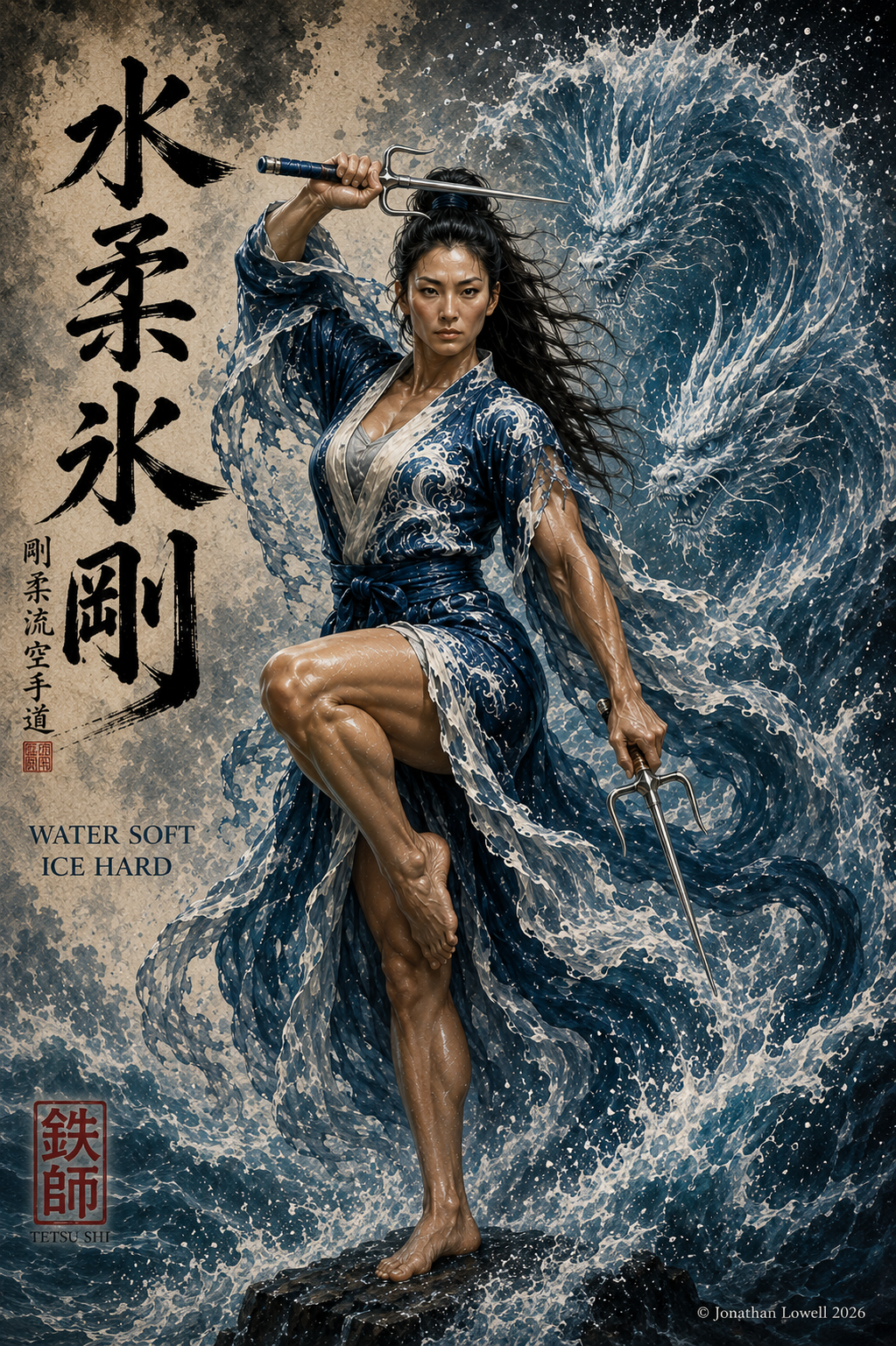
This understanding inspired my artistic interpretation of Busaganashi.
In my painting, Busaganashi appears as a powerful female guardian balanced in the traditional posture. She carries Sai representing both Okinawan martial culture and possible maritime symbolism. Behind her rises a great ocean wave from which a dragon emerges.
The dragon is not separate from the sea.
It is the spirit of the sea itself.
The ocean rages.
The dragon moves.
Yet Busaganashi remains perfectly balanced.
The accompanying phrase reads:
Water Soft — Ice Hard
To me, these words express the essence of Goju-Ryu.
Softness and hardness.
Movement and stillness.
Adaptability and strength.
Different expressions of one reality.
This artwork is not intended as a historical reconstruction. Rather, it is my personal reflection, inspired by the Bubishi, Okinawan tradition, Southern Chinese influences, and more than fifty years devoted to the study of Goju-Ryu Karate-Do.
Final Thoughts
Whether Busaganashi ultimately proves to have been associated with fire, water, or another tradition entirely remains a question for continued research.
For me, however, the greater value lies not only in discovering history, but in allowing history to deepen our practice.
Like water, we must learn to adapt.
Like steam, we must learn to expand beyond our limitations.
Like ice, we must learn to become focused and enduring.
And like Busaganashi, we must remain balanced amid the storms of life.
Perhaps that is the enduring spirit of Goju-Ryu.
Osu.
About the Author
Jonathan Lowell ("The Iron Sensei") has practiced Goju-Ryu Karate-Do for more than fifty years. A lifelong student of Okinawan karate, the Bubishi, martial history, and traditional training methods, he writes The Iron Sensei Journal to explore the history, philosophy, health, and enduring lessons of the martial arts.
For more than fifty years, I have studied under many remarkable martial artists. Some were exceptional teachers. Others were brilliant technicians, scholars, or professors of karate. From each I learned something that helped shape my understanding of the martial arts. But I had only one Sensei.
That was Peter Urban.
Urban's credentials alone secured his place in karate history. He was the first Westerner to earn a high dan rank under Gogen Yamaguchi, the legendary "Cat," and he played a pioneering role in introducing Goju-Ryu Karate to America, influencing generations of students who followed. Yet a résumé tells only part of the story.
He was also an artist of the Dadaist school, a musician, an unconventional thinker, and held a Ph.D. in Psychology. His mind never seemed content to stay within ordinary boundaries. Some people called him crazy. I always thought that if he'd been a millionaire, they would have called him eccentric. He later founded Zen Psychotherapy, combining Eastern philosophy with Western psychology in a way that reflected the unique way he looked at life.
Whatever history says about his karate, his personality, or the controversies that surrounded him, no one can take away what he gave me. He gave me my start. He taught me how to fight. More importantly, he taught me how to live.
One sentence he spoke has remained with me for more than fifty years:
"A black belt is learning how to take care of yourself really well."
When I was young, I thought he was talking about fighting. Today, I know he was talking about life.
That one sentence has guided me through karate, business, relationships, health, and growing older. Looking back, I realize that Sensei Urban wasn't teaching me how to win tournaments. He was teaching me how to become responsible for my own life.
That lesson brings us to the subject of this article.
Most people think Zen is about sitting cross-legged, burning incense, and saying mysterious things. It isn't.
Zen is reality.
Zen is learning to live completely in the present moment. Not tomorrow. Not yesterday. Right now.
The past is memory. The future is imagination. Life happens only now.
That sounds simple, but very few people actually live that way. Most people spend their lives worrying about tomorrow, regretting yesterday, or waiting for the "right time." There is no right time. There is only now.
That is one of the greatest lessons Sensei Urban ever taught me, although he rarely used the word "Zen." He simply lived it.
He had an expression that I have never forgotten. He called it shunting.
Shunting wasn't exactly procrastination, although procrastination was certainly part of it. Shunting meant avoiding responsibility. It meant knowing what needed to be done but pushing it aside because it was uncomfortable.
The dishes stay in the sink.
The bills don't get paid.
The workout gets skipped.
The difficult phone call never gets made.
The book never gets written.
Sound familiar?
We've all done it.
Urban had no patience for shunting. His attitude was simple. If something needed to be done, you did it. You didn't wait until tomorrow because tomorrow had a funny habit of never arriving.
Wash the dishes.
Pay the bills.
Train today.
Write today.
Make the phone call today.
Life is built one decision at a time.
That, to me, is Zen.
Not perfection.
Responsibility.
Awareness.
Action.
What Is Zen?
Most people think Zen is a religion. Others think it's some mysterious Eastern philosophy understood only by monks sitting on mountaintops.
I think they're both missing the point.
Zen traces its roots back more than 2,500 years to Siddhartha Gautama, the historical Buddha. The word itself began as the Sanskrit word dhyāna, meaning meditation. It became Chan in China and eventually Zen in Japan. But Zen has always been much more than meditation. It is a way of seeing reality clearly.
Unlike many religious traditions, Zen places less emphasis on belief and much greater emphasis on direct experience. Instead of asking, "What should I believe?" Zen asks, "What is happening right now?"
According to tradition, the Buddha once held up a flower during a sermon and said nothing. Only one disciple, Mahākāśyapa, smiled. That silent understanding became the symbolic beginning of Zen—a direct transmission from teacher to student beyond words.
Whether the story is historical or symbolic really doesn't matter. The lesson does. Reality cannot always be explained. Sometimes it has to be experienced.
That appealed deeply to the samurai of Japan. Life and death were everyday realities. There was no time for endless debate. You had to see clearly, remain calm, and act decisively.
That same mindset carries over into karate.
When someone throws a punch, you don't stop to analyze it.
You respond.
Immediately.
Completely.
Without hesitation.
That is Zen in motion.
Zen also teaches that ordinary life is the real dojo. Walking, eating, working, cleaning, training, listening, and even washing the dishes become opportunities to practice awareness. Every moment becomes training if you pay attention.
People often ask me whether Zen is a religion or a philosophy.
Historically, it is both.
But in my own life, Zen has become something very practical. It teaches responsibility. Discipline. Presence. Clear thinking. Personal growth. Those lessons belong to everyone, regardless of what religion they practice.
You don't have to become a monk.
You simply have to wake up.
Wake up to your habits.
Wake up to your excuses.
Wake up to your opportunities.
Wake up to your own life.
Because...
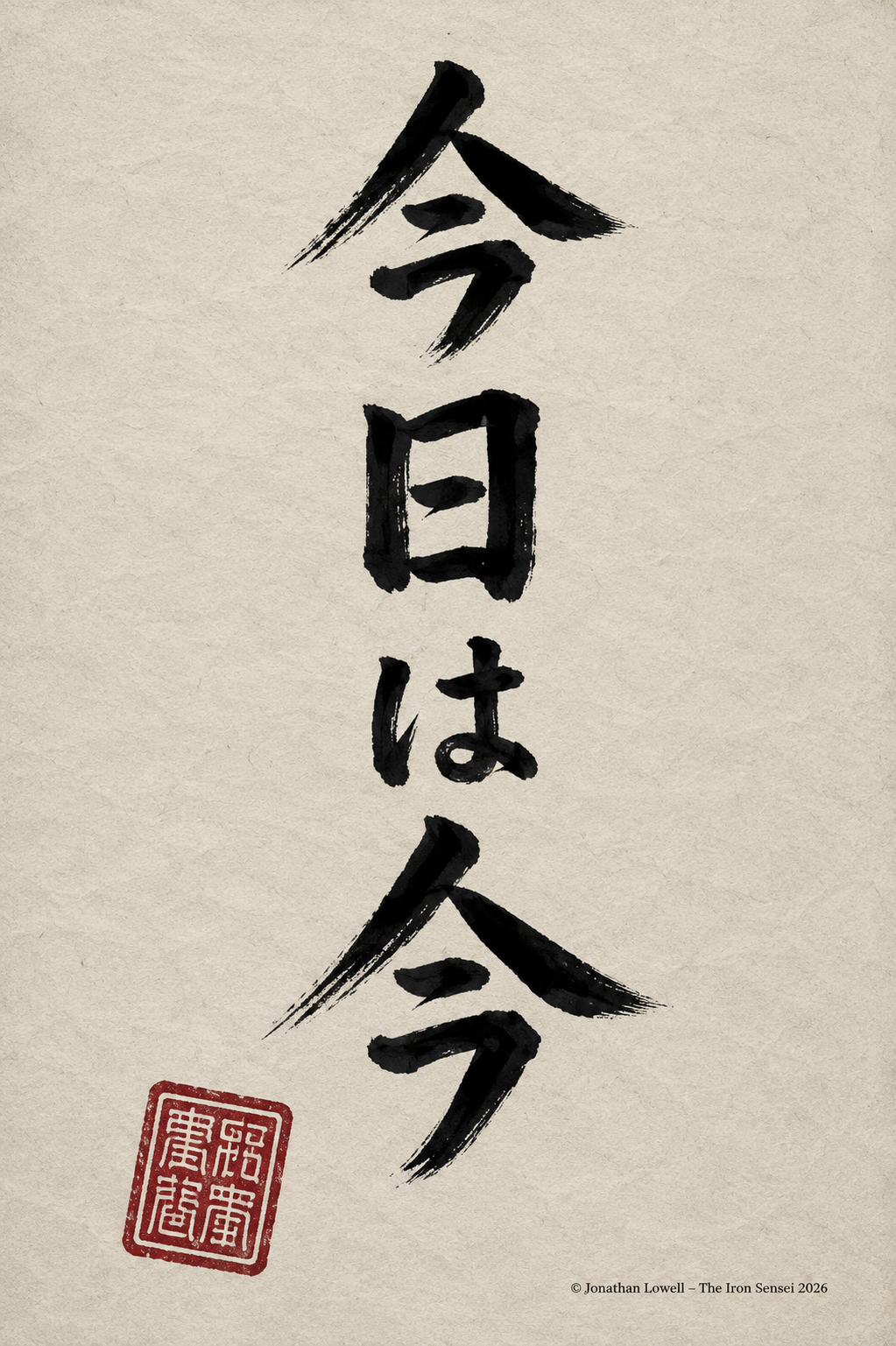
Today is now.
The Power of Now
The past is memory. The future is imagination. Life happens only now.
We all have a past. Some of it is wonderful. Some of it we wish had never happened. We all make mistakes. We all carry regrets. Learn from them, but don't live there. The past is a teacher, not a prison.
The future is important too. It is good to have dreams and goals. But dreaming without action is fantasy. Too many people spend their lives waiting for the perfect time to begin. They tell themselves, "I'll start next Monday. I'll start when I have more money. I'll start after the holidays. I'll start when I retire."
Before they know it, years have gone by.
The real question is much simpler.
What can I do today?
Can I walk another ten minutes? Can I add five pounds to the bar? Can I lose two pounds this month? Can I become a better father, husband, wife, friend, or student? Can I become just a little better than I was yesterday?
Life changes one decision at a time.
People sometimes ask me how I rebuilt my health after four heart attacks. The answer isn't dramatic. I didn't wake up one morning transformed. I trained one workout. I ate one good meal. I took one walk. Then I did it again the next day. Small decisions, repeated over time, become a different life.
That is the power of now.
Most people become overwhelmed because they look too far ahead. "I have to lose fifty pounds." "I have to write a book." "I have to change my whole life."
No, you don't.
You simply have to make one good decision. Then another. Then another. Mountains are climbed one step at a time. Lives are rebuilt exactly the same way.
DO • BE • HAVE
Over the years I've come to believe that most people have life backwards.
They think, "When I have enough money, then I'll be successful. Once I'm successful, then I'll do the things successful people do."
It doesn't work that way.
The order is exactly the opposite.
First you DO.
You train. You study. You work. You save. You write. You practice. You show up when you don't feel like showing up. Those actions slowly become habits.
Your habits become your character.
Eventually, you BE that person.
A disciplined person.
A healthier person.
A dependable person.
A successful person.
Only then do you begin to HAVE the things everyone else notices. The better body. The successful business. The black belt. The confidence. The respect.
People admire the results. They rarely see the thousands of ordinary decisions that produced them.
That is one of the great lessons of Zen. Stop chasing results. Concentrate on today's actions. If your actions are correct, the results will eventually take care of themselves.
Be an Implicit Actionist
Thinking is cheap. Action creates reality.
I don't care how many books you've read if you've never applied what you've learned. I don't care how many motivational videos you've watched if you never get off the couch. Knowledge without action is little more than entertainment.
Action is transformation.
One of the biggest lies we tell ourselves is, "I'm waiting until I'm ready."
Ready for what?
You'll never feel completely ready. The perfect moment doesn't exist.
If you're overweight, face reality. Don't blame your age, your metabolism, or your circumstances. Accept where you are, then begin. Walk. Lift weights. Eat one better meal. Make one better decision. Tomorrow, make another.
Pay attention to how you speak to yourself. If you constantly tell yourself you're old, fat, weak, or a failure, your mind begins to believe it.
Buddhism has a wonderful concept that can help anyone, regardless of religion: Mudra, Mantra, and Mandala.
Mudra is action. Move your body. Walk. Practice karate. Lift weights. Do yoga. Train.
Mantra is your self-talk. Every day you're carrying on a conversation with yourself. Make sure it's moving you toward the person you want to become instead of reminding you why you can't.
Mandala is inspiration. For a monk it may be a beautiful sand mandala. For you it may be a photograph of your family, your Sensei, your children, a great athlete, or anyone who reminds you of the person you're trying to become.
Move your body.
Guide your mind.
Feed your spirit.
Then get up...
...and do something.
Because today is now.
Master Taisen Deshimaru
One of my favorite Zen teachers is Master Taisen Deshimaru, who brought the Sōtō Zen tradition from Japan to Europe. He once said:
"Live as though your hair were on fire."
At first, that sounds dramatic. But he wasn't telling us to panic. He was teaching urgency.
Deshimaru also understood martial arts. Born into a samurai family, he practiced jujutsu and understood that the martial path was never simply about learning to fight. Like the sword masters of old, he believed the real battle was mastering your own mind.
That idea has stayed with me throughout my life.
My parents thought I was crazy for wanting to make a living teaching karate. Looking back, I understand why. It wasn't an easy path, and there were certainly easier ways to earn a paycheck.
But I never wanted an easy life.
I wanted a meaningful one.
Years ago, someone asked me a question I've never forgotten.
"If I gave you a million dollars, but in exchange you lost every martial arts experience you've ever had—every lesson, every student, every tournament, every memory—would you take it?"
The answer surprised even me.
No.
A million dollars would be wonderful.
But the experiences are priceless.
Money comes and goes.
The journey becomes part of who you are.
Perpetual Self-Improvement (PSI)
Sensei Urban often spoke about Perpetual Self-Improvement.
PSI.
That idea became one of the foundations of my own teaching.
Urban wanted his students to surpass him. He encouraged us to attend college, build careers, become professionals, and become experts in our own fields. He wasn't trying to create followers for life. He was trying to create independent, successful people.
That, to me, is the responsibility of every good teacher.
A Sensei should want the student to become better than the teacher.
Improve one thing every day.
Your body.
Your mind.
Your character.
Your spirit.
Read another chapter.
Learn another technique.
Walk another mile.
Help another person.
You don't have to become a completely different person overnight.
You simply have to become a slightly better version of yourself today than you were yesterday.
Do that often enough, and extraordinary things begin to happen.
The Now Generation
When I say The Now Generation, I'm not talking about the old slogan from the 1960s.
I'm talking about a way of living.
The Now Generation is made up of people who stop waiting for permission. They don't spend years making excuses. They don't blame their parents, their age, their circumstances, or bad luck. They accept reality, take responsibility, and begin.
Today.
One of the funniest stories I remember from Urban's dojo involved a man who desperately wanted his black belt. In karate, you never ask for rank. It comes when your teacher believes you're ready. But this student kept asking, and asking, and asking.
Finally, Urban wrote out the promotion certificate and said, "Come to black belt class."
The man came.
He quickly discovered he couldn't keep up with the black belts. He wasn't physically or mentally prepared for what the rank represented.
That was a lesson in Zen.
Reality doesn't care what we wish were true.
Reality simply is.
Eventually he did receive his certificate, but by then he understood something he hadn't understood before.
The belt was never the goal.
The person wearing it was.
That lesson has stayed with me ever since.
Closing
Life is short.
Death is long.
Those words aren't meant to frighten anyone. They're meant to remind us that our time here is limited.
There is no perfect moment.
There is no someday.
There is today.
Train today.
Write today.
Make the phone call today.
Tell your family you love them today.
Take responsibility today.
Don't compare yourself to other people. Everyone begins from a different place. Some have better genetics. Some have more money. Some have more talent. None of that changes what you have to do.
Your only competition is the person you were yesterday.
Become a little stronger.
A little wiser.
A little kinder.
A little more disciplined.
One decision.
One workout.
One page.
One act of courage.
That is how lives are changed.
When I was a young karate student, I thought my Sensei was teaching me how to fight.
After more than fifty years, I finally understand.
He was teaching me how to live.
Today is now.
Don't waste it.
About the Author
Jonathan Lowell ("The Iron Sensei") has trained in Goju-Ryu Karate-Do for more than 50 years. He is a martial artist, author, former school owner, personal trainer, and health coach who has taught thousands of students. Through The Iron Sensei Journal, he shares practical insights on karate, health, fitness, philosophy, and personal transformation to help others build strength in body, mind, and spirit.
Many people assume Osu is simply a Japanese way of saying "hello" or "yes." It isn't. It carries a much deeper meaning.
Interestingly, Osu is used far more in mainland Japan than in Okinawa. Okinawans tend to be very protective of their own traditions, and many Okinawan karate schools rarely use the word. They often prefer Hai, Sensei ("Yes, Sensei") instead.
So where did Osu come from?
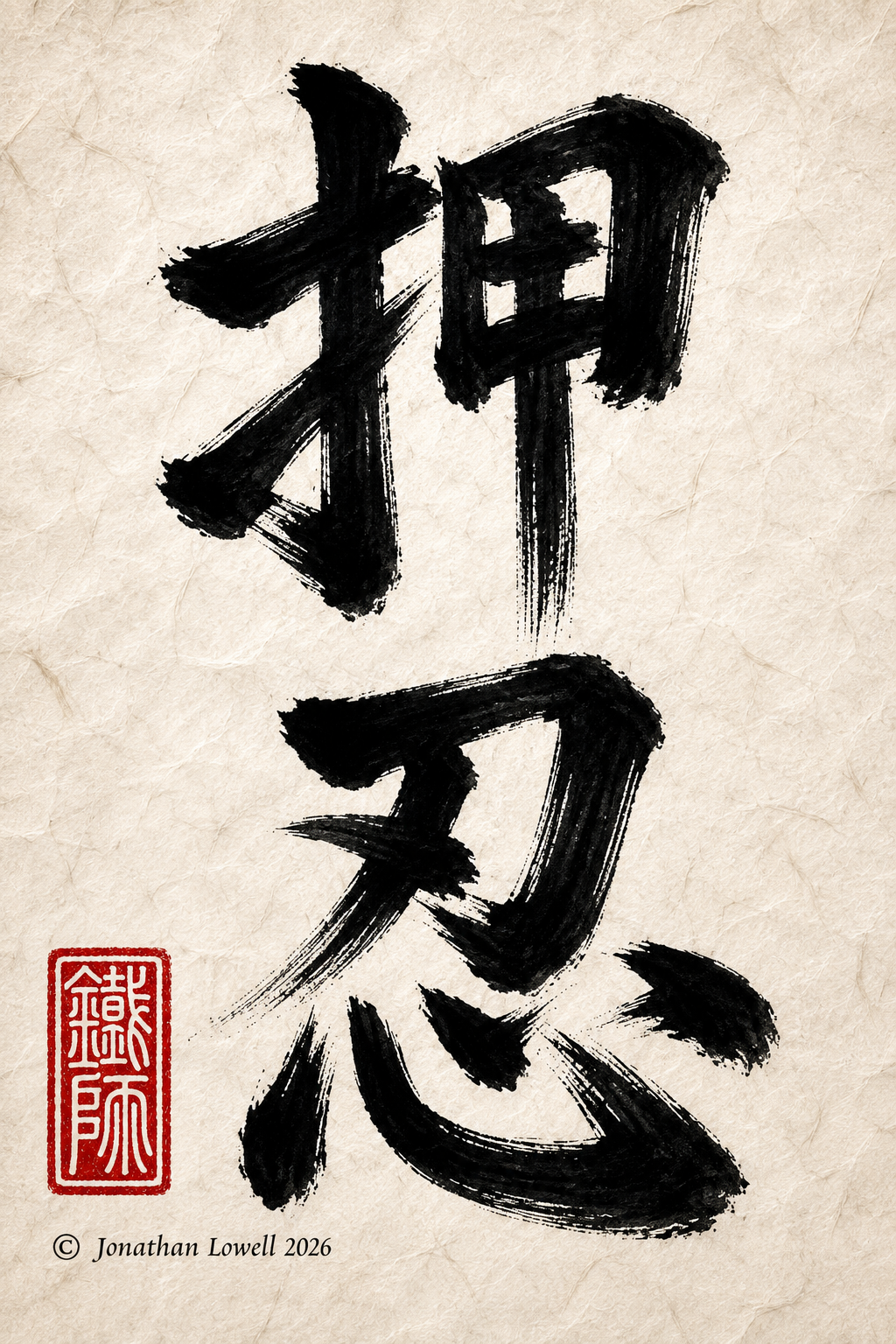
It is generally believed to be a shortened form of the phrase Oshi Shinobu, meaning "to push and endure." Over time, the phrase was shortened into the single word Osu, pronounced "Oss."
My understanding is that it became popular in Japanese universities during the 1930s, particularly in Judo clubs. Students trained hard, encouraged one another, and answered their instructors with a strong, confident "Osu!"
Eventually, it became much more than encouragement. It became an acknowledgment.
The instructor would say, "Train harder."
The class would answer, "Osu!"
"Do you understand?"
"Osu!"
You might even meet another student on the street and greet him with "Osu!"
When karate spread through the Japanese universities, many customs from Judo came with it. The gi, the colored belt ranking system, formal bowing, meditation, and the use of Osu all became common in many Japanese martial arts, including Karate, Kendo, and others.
Although I practice Okinawan Goju-Ryu Karate-Do, I still use Osu in my dojo.
I appreciate many aspects of Japanese budo—the structure, discipline, and respect. My own teaching has always reflected both the Okinawan and Japanese traditions.
People often think Goju-Ryu in Japan is completely different from Goju-Ryu in Okinawa. In my opinion, the differences are usually matters of emphasis rather than entirely different systems. One dojo may focus more on kumite, another on kata, and another on competition. Even within Okinawa, two instructors may teach the same kata a little differently based on their own understanding and experience.
So should you say Osu?
Yes... but don't overdo it.
In Okinawa, you will often hear Hai, Sensei instead. In some Japanese dojos, you'll hear Osu after almost everything the instructor says.
Personally, I think both can be overused.
I once had a very sincere student who answered almost every sentence with "Hai!" or "Osu!" It came from respect, but after a while it became almost automatic.
For me, Osu has the greatest meaning when it is used at the right moment.
One word.
One spirit.
Push on. Endure. Continue.
Osu.
Jonathan Lowell ("The Iron Sensei") has practiced Goju-Ryu Karate-Do for more than fifty years. A lifelong student of Okinawan karate, the Bubishi, martial history, and traditional training methods, he writes The Iron Sensei Journal to explore the history, philosophy, health, and enduring lessons of the martial arts.
About the Author Jonathan Lowell ("The Iron Sensei") has practiced Goju-Ryu Karate-Do for more than fifty years. A lifelong student of Okinawan karate, the Bubishi, martial history, and traditional training methods, he writes The Iron Sensei Journal to explore the history, philosophy, health, and enduring lessons of the martial arts
Remembering Sensei David Jainchill, "The Real Zatoichi"
By Jonathan Lowell (The Iron Sensei)
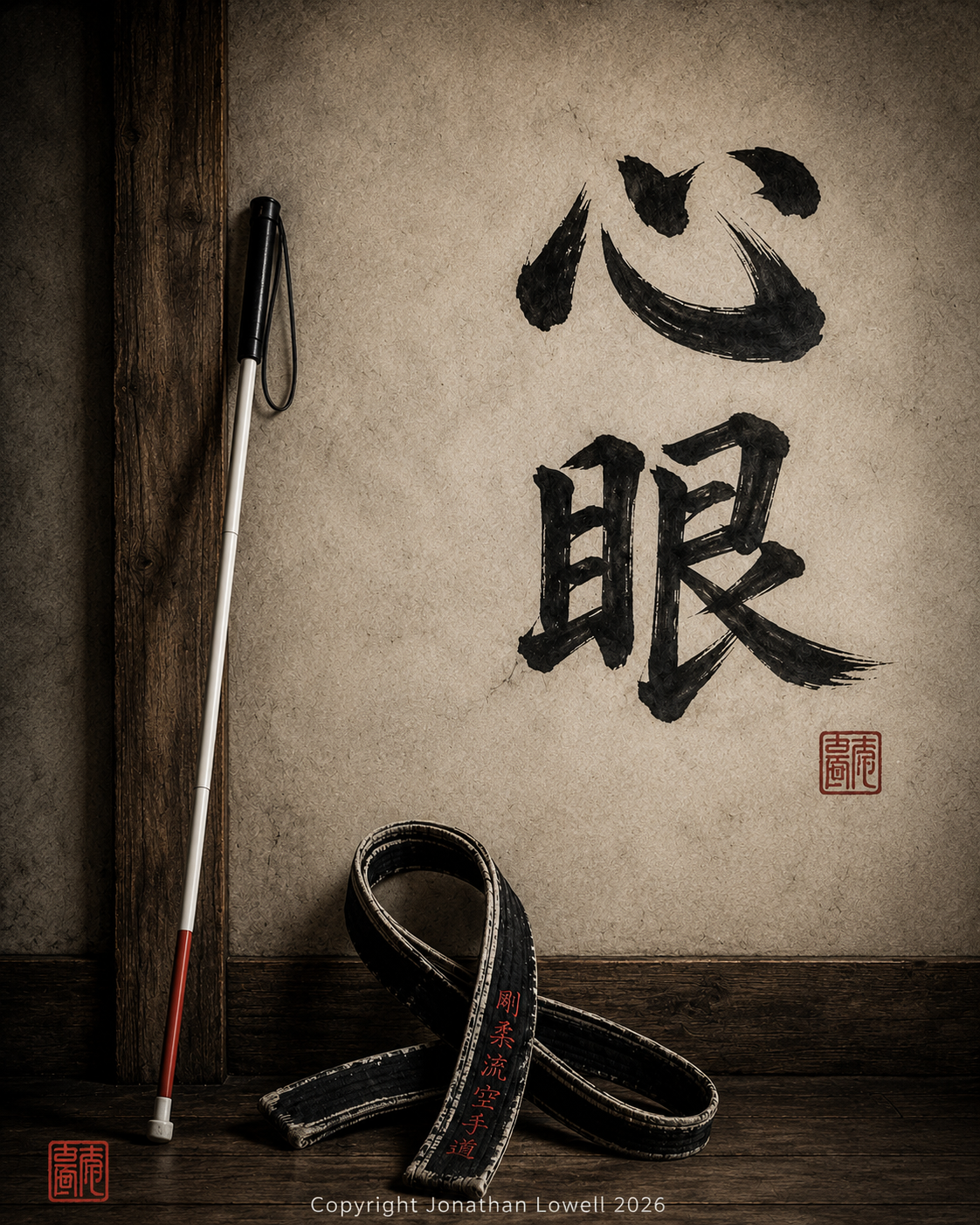
Most martial artists know the fictional blind swordsman Zatoichi. I had the privilege of knowing the real one.
His name was Sensei David Jainchill.
This is not the story of a blind man.
It is the story of a karateka.
To understand David, you first have to understand the karate world I grew up in.
There was an incredible Goju-Ryu karate scene in New York during the 1960s and 1970s. Peter Urban had his famous Chinatown dojo, where many outstanding martial artists got their start. As happens in every generation, students eventually went in different directions. Some remained loyal to Urban's USA Goju. Some stayed with Yamaguchi and the Goju Kai. Others formed organizations of their own.
One of the most respected was Frank Ruiz, founder of Nisei Goju, literally "Second Generation Goju." Ruiz produced some of the finest fighters in America. Louis Delgado immediately comes to mind. During the 1970s, Delgado was ranked the number one fighter in America by Black Belt Magazine and even defeated Chuck Norris in competition. Although Ruiz built his own organization, he always respected Peter Urban.
Eventually Ruiz moved to Miami, while the legendary Wifredo Roldan continued leading Nisei Goju in New York. One of Ruiz's senior students, John Giordano, also moved to Miami and opened a dojo in Miami Beach. Giordano was a tournament champion, a superb instructor, and one tough karate man. His dojo produced many outstanding black belts.
One of them became my Senpai and one of my closest friends for more than thirty years—Sensei John Tronolone.
John was a multiple Florida champion in kata and kumite. Like me, he eventually wanted to explore the traditional Okinawan roots of Goju-Ryu and began training with Morio Higaonna Sensei.
I first met John at a Matayoshi Kobudo seminar in Miami in 1993. Shinpo Matayoshi was teaching, assisted by one of his senior students, Kimo Wall. We hit it off immediately, became close friends, and eventually I became John's assistant instructor in his Miami dojo.
One afternoon we stopped for fresh Cuban juice at a little comida Latina restaurant. John smiled and said,
"I want you to meet somebody."
We drove to a small efficiency apartment in Miami Beach.
That's where I met David Jainchill.
David was completely blind.
Before losing his eyesight to retinitis pigmentosa, he had worked as a hairdresser in the Catskills. When most people would have accepted that life had changed forever, David did something remarkable.
He started karate.
Completely blind.
John Giordano accepted him as a student, and David's determination quickly earned everyone's respect. Eventually, David became Giordano's assistant instructor and taught my Senpai, John Tronolone, from white belt all the way through black belt.
Think about that for a moment.
A completely blind man teaching karate.
And not just teaching...
Competing.
David entered tournaments in kata and kumite. He won many of them. John told me about one tournament where David defeated a man in kumite, and his opponent never even realized David was blind.
David wasn't cautious.
He loved to fight.
He trained like a boxer. Skipping rope was his trademark. He could perform trick after trick with incredible rhythm and precision. His hands were lightning fast, his combinations sharp, and he was constantly circling to find angles. Even without sight, his movement reflected classic Goju-Ryu principles—circles and straight lines flowing together.
His trademark technique was a jumping spinning back kick. He developed such sensitivity that he could feel an opponent's movement and timing. When an arm extended into range, David could launch that kick with astonishing accuracy.
His apartment reflected who he was.
It wasn't fancy.
In one corner hung a small double-end striking bag suspended on elastic cords. It bounced and danced after every punch or kick, yet David struck it with ease. Watching him train was fascinating. He didn't need to see the target.
He knew where it was.
David also taught karate and yoga at the Fontainebleau Hotel in Miami Beach.
How Miami is that?
His daily routine never changed.
Coffee.
A Camel cigarette.
Then, with that unmistakable Catskills Jewish sense of humor, he'd joke in Yiddish:
"Ess un gadank!"
"Eat and shit."
Then came an hour of yoga.
Then an hour of karate.
Every day.
David loved women, and believe it or not, he had plenty of girlfriends. One would often bring him food. He loved music, conversation, and philosophy. Because he couldn't read, John would read Alan Watts to him. David was Jewish, deeply spiritual, and had a quiet Zen-like outlook on life that I always appreciated.
Peter Urban loved David. And gave him the nickname "Zatoichi"
David would call Urban often, and the two spoke regularly. Urban respected him immensely and eventually promoted him to 7th Dan. After David's passing, he was posthumously awarded 9th Dan.
As John continued studying Okinawan Goju-Ryu, he patiently taught David every Okinawan kata. Together they worked through them all. Eventually, we brought David to train with Morio Higaonna Sensei, who was genuinely impressed and spent time working with him.
I also remember bringing David to gasshuku.
John would guide him with his white cane and place him in line.
Then the cane was quietly set aside.
Training began.
David bowed with everyone else.
Worked out with everyone else.
Sweated with everyone else.
He wasn't "the blind student."
He was simply another karateka.
David passed away in 2010 from lung cancer.
The cigarettes eventually caught up with him.
But that isn't how I remember my Senpai.
I remember his laughter.
His Catskills humor.
The sound of the jump rope.
The little striking bag.
The coffee.
The Camel.
The yoga.
The lightning-fast hands.
The incredible spinning back kick.
His friendship with Urban.
His trust in John.
His determination to keep walking the Way no matter what life took from him.
Most people know the fictional blind swordsman Zatoichi.
I had the privilege of knowing the real one.
David eventually lost his eyesight.
But he never lost his vision.
Perhaps that is what the old masters meant by Shingan (心眼)—
The Mind's Eye.
Osu, Senpai.
About the Author
Jonathan Lowell, known as The Iron Sensei, has trained in Goju-Ryu Karate-Do for more than five decades. A student of Peter Urban and Morio Higaonna, he has competed, taught thousands of students, and operated his own dojo for over twenty years. He is also a licensed massage therapist, author of The Hallandale Diet, and founder of Iron Rebuild, helping adults over 40 reclaim their health, strength, and confidence. Through The Iron Sensei Journal, he preserves the history, philosophy, and living traditions of karate while sharing lessons from a lifetime on the Way.
This article is dedicated to the memory of Sensei David Jainchill, whose example reminds us that true vision comes not only from the eyes, but from the spirit.
I'm sixty-six years old, and after more than fifty years of training in Goju-Ryu Karate, I'm still a student.
People sometimes ask me why I'm studying Southern Praying Mantis Kung Fu. They wonder why I spend time reading old books, researching the Bubishi, writing articles about Busaganashi, and exploring the Chinese roots of Okinawan karate.
The answer is simple.
A Sensei who stops being a student stops growing.
Over the years I've met many kinds of instructors.
Some earned their black belts, opened schools, taught classes, attended seminars, paid their federation dues, and every few years received another promotion. Some built large schools, became tournament directors, or held influential positions within their organizations.
There is nothing wrong with building a successful school. Teaching is an honorable calling.
But I have always admired another path.
The instructors who remained students.
The ones who trained under their teachers for years before opening a dojo. The ones who traveled to learn. The ones who competed—not just as judges or referees, but as competitors willing to put everything on the line.
Owning a school and competing takes courage.
If you lose, you lose in front of your students.
There are no excuses.
I remember when I was the assistant instructor under my senpai, John Tronolone. We attended a tournament, and I placed third in kata. I walked away with a beautiful trophy.
It wasn't just the trophy that mattered.
It was knowing that my students saw me step onto the floor, put in the work, and earn my place.
They saw the receipts.
In martial arts, rank is awarded.
Experience is earned.
The bruises.
The early mornings.
The long drives to seminars.
The corrections from your teacher.
The victories.
The defeats.
Those are the receipts that no certificate can replace.
Even today, at sixty-six years old, I'm still researching.
I'm studying Southern Praying Mantis.
I'm comparing Chinese and Okinawan traditions.
I'm exploring the history of the Bubishi.
I'm asking questions about kata that I never thought to ask thirty years ago.
Some people think reaching a high rank means you've arrived.
I think it means you've earned the privilege of asking better questions.
Chojun Miyagi, the founder of Goju-Ryu Karate, once observed that studying karate without a teacher is like walking in the dark without a lantern. While the great masters were still alive, he believed we should seek them out, ask questions, and learn everything we could from them.
That humility has always stayed with me.
If the founder of Goju-Ryu still considered himself a student, why should I ever believe my own education is complete?
Peter Urban never stopped exploring.
Morio Higaonna never stopped researching.
The greatest teachers I've known were also the greatest students.
That is the path I hope to walk for the rest of my life.
Not simply to teach karate.
Not simply to wear another stripe on my belt.
But to remain curious.
To remain humble enough to say, "I don't know."
To keep learning for as long as I can stand in Sanchin.
Because in the end, I believe the finest compliment anyone could pay a martial artist is not that he became a great Sensei.
It is that, after a lifetime of teaching, he never stopped being a student.
Osu.
About the Author
Jonathan Lowell, known as The Iron Sensei, has trained in Goju-Ryu Karate-Do for more than five decades. A student of Peter Urban and Morio Higaonna, he has competed, taught thousands of students, and operated his own dojo for over twenty years. He is also a licensed massage therapist, author of The Hallandale Diet, and founder of the online coaching program Iron Rebuild, where he helps men and women over 40 lose weight, build strength, improve their health, and regain confidence. Through The Iron Sensei Journal, he shares the history, philosophy, and living traditions of karate while drawing on a lifetime of training and continuous study.
I have been training in karate since I was nine years old.
My first Sensei was Peter Urban. I trained with his black belts out on Long Island, and when I was old enough, I would take the train into New York City every Saturday to train with Urban Sensei himself. Back then, I didn't know there were different styles of karate. Karate was karate.
I was just a kid, and I was tolerated more than anything else. I kept my mouth shut and trained.
Those were different times. The Vietnam War was still going on. Many police officers trained in the dojo, and there weren't many kids or women on the floor. It was a serious place. Nobody was there to socialize. You trained hard, and you earned your place.
As I grew older, I heard stories about the legends of karate. One name fascinated me more than any other—Gogen Yamaguchi, "The Cat." I dreamed that one day I would train with him.
As a junior competitor, I continued to compete and study. Information about karate was scarce in those days. There was no Internet, no YouTube, and very few books. If you wanted to learn, you had to find someone who knew more than you did and get on the floor.
Eventually, I found my way to the Shorei-Kan Goju-Ryu dojo in Manhattan. It was there that I really began to understand traditional Okinawan Goju-Ryu.
Around that time, I kept hearing about an Okinawan instructor in Spokane, Washington—Teruo Chinen.
At a tournament, I met one of Chinen Sensei's students. She performed Shishochin Kata beautifully. We started getting together informally to practice kata, and I remember telling her, "One day I'm going to train with Chinen Sensei."
I had no idea how that dream would unfold.
Everything changed in 1990 when Morio Higaonna came to New York.
Watching Higaonna Sensei was one of those rare moments when you realize your understanding of karate has just changed forever. I learned that he and Chinen Sensei had both trained under Eiichi Miyazato in Okinawa and that Chinen was Higaonna's junior training brother.
I became Higaonna Sensei's student and followed him around the country for nearly twenty years, attending seminars whenever I could.
Over the years, I also had opportunities to train with Chinen Sensei.
People often asked me what the difference was between the two.
I always tell them there wasn't a difference in the karate itself. Both were exceptional. The difference was in the expression.
Higaonna Sensei was like a battleship with enormous guns. Chinen Sensei was like a jet fighter—fast, precise, and incredibly technical.
Even today, many of the kihon drills and teaching methods I use with my own students come directly from Chinen Sensei.
Then I learned something that stayed with me.
Chinen Sensei had diabetes.
He was diagnosed in 1995, although I'm convinced he probably had it long before then. Around 2010, complications from diabetes led to the amputation of his lower left leg.
Most people would have retired.
Not Chinen Sensei.
He continued traveling the world, teaching seminars, demonstrating karate, and inspiring students while wearing a prosthetic leg. He eventually passed away in 2015 from complications related to diabetes.
Another martial arts giant who lived with diabetes was Carlson Gracie.
Carlson was one of the most important figures in Brazilian Jiu-Jitsu and Vale Tudo. His influence on modern MMA is impossible to overstate. He also battled diabetes before his death in 2006.
For years, I watched diabetes affect martial artists I admired.
I never imagined it would happen to me.
Then one day, I was admitted to the hospital with pneumonia.
I was incredibly sick.
The doctor walked into my room and said, "You have Type 2 diabetes. Your blood sugar is out of control."
I was stunned.
They immediately started me on insulin and antibiotics.
Suddenly, I was injecting insulin after every meal and pricking my fingers several times a day to test my blood sugar. It hurt. It was inconvenient. It was depressing.
I remember thinking, How did this happen to me?
Eventually, my blood sugar improved. My A1c dropped into the normal range, and I was switched to a single long-acting insulin injection at night. It was progress, but I still hated every shot.
Then life got harder.
I suffered my first heart attack.
At the time, I was teaching karate every day and training constantly. Years of stress had taken their toll. My marriage eventually ended in divorce, and over the following years I suffered three more heart attacks.
The last one, in 2018, nearly killed me.
The doctors began talking about a heart transplant.
I was sent to a transplant hospital in Orlando for evaluation. My heart's ejection fraction had dropped to around thirty percent.
Those were frightening days.
My ex-wife went with me to one of the appointments. A mutual friend whose husband had undergone a heart transplant became someone we leaned on for support because we simply didn't know what the future held.
I honestly didn't know if I was running out of time.
But I wasn't ready to quit.
I walked every day.
I stayed disciplined with my nutrition.
I kept moving.
Slowly, I started coming back.
Then Planet Fitness opened near where I lived.
Walking into that gym changed my life.
The gym became more than a place to lift weights.
It became therapy.
It became church.
Every workout reminded me that I was still alive and still capable of improving.
Little by little, I grew stronger.
I rebuilt my body.
I rebuilt my confidence.
Despite everything, I eventually accumulated nine coronary stents.
People joke that cats have nine lives.
Sometimes I smile and think maybe they're right.
Then, in 2023, another challenge appeared.
One morning my ankles started swelling.
I called my cardiologist, and he told me to come into the office immediately.
My first thought was, Is this it?
After examining me, he said, "You need a pacemaker."
That very day, I checked into the hospital.
I wasn't thrilled about having a device implanted in my chest.
My biggest question wasn't about the surgery.
It was, "Doctor...how long before I can get back in the gym?"
Fortunately, my cardiologist was a weightlifter himself.
He smiled and said, "Give it a month."
That's all I needed to hear.
One month later, I was back.
Slowly at first.
Then with a vengeance.
I wasn't trying to become the man I used to be.
I wanted to become better.
Eventually I moved back to Miami.
At my doctor's recommendation, I wrote The Hallandale Diet.
That book eventually led to coaching people who were facing many of the same challenges I had lived through.
People often say you can reverse Type 2 diabetes.
That's not really accurate.
For many people, it can be put into remission.
That's what I did.
It didn't happen through magic.
It didn't happen through shortcuts.
It happened through discipline.
One meal.
One workout.
One walk.
One day at a time.
Today my doctors are pleased with my health, and I continue to train, lift weights, and teach.
I've lived through diabetes.
I've survived four heart attacks.
I train with a pacemaker.
And I know what it feels like to think your life is over.
It isn't.
If you're struggling with Type 2 diabetes, recovering from a heart attack, or simply trying to become stronger as you get older, understand this:
You are not broken.
Your best years may still be ahead of you.
I've walked that road.
Now I'd be honored to walk it with you.
Osu.
About the Author
Jonathan Lowell, known as The Iron Sensei, has trained in Goju-Ryu Karate-Do for more than five decades. A student of Peter Urban and Morio Higaonna, he has competed, taught thousands of students, and operated his own dojo for over twenty years. He is also a licensed massage therapist, author of The Hallandale Diet, and founder of the online coaching program Iron Rebuild, where he helps men and women over 40 lose weight, build strength, improve their health, and regain confidence. Through The Iron Sensei Journal, he shares the history, philosophy, and living traditions of karate while drawing on a lifetime of training and continuous study.
Sensei Peter Urban had another expression he used often.
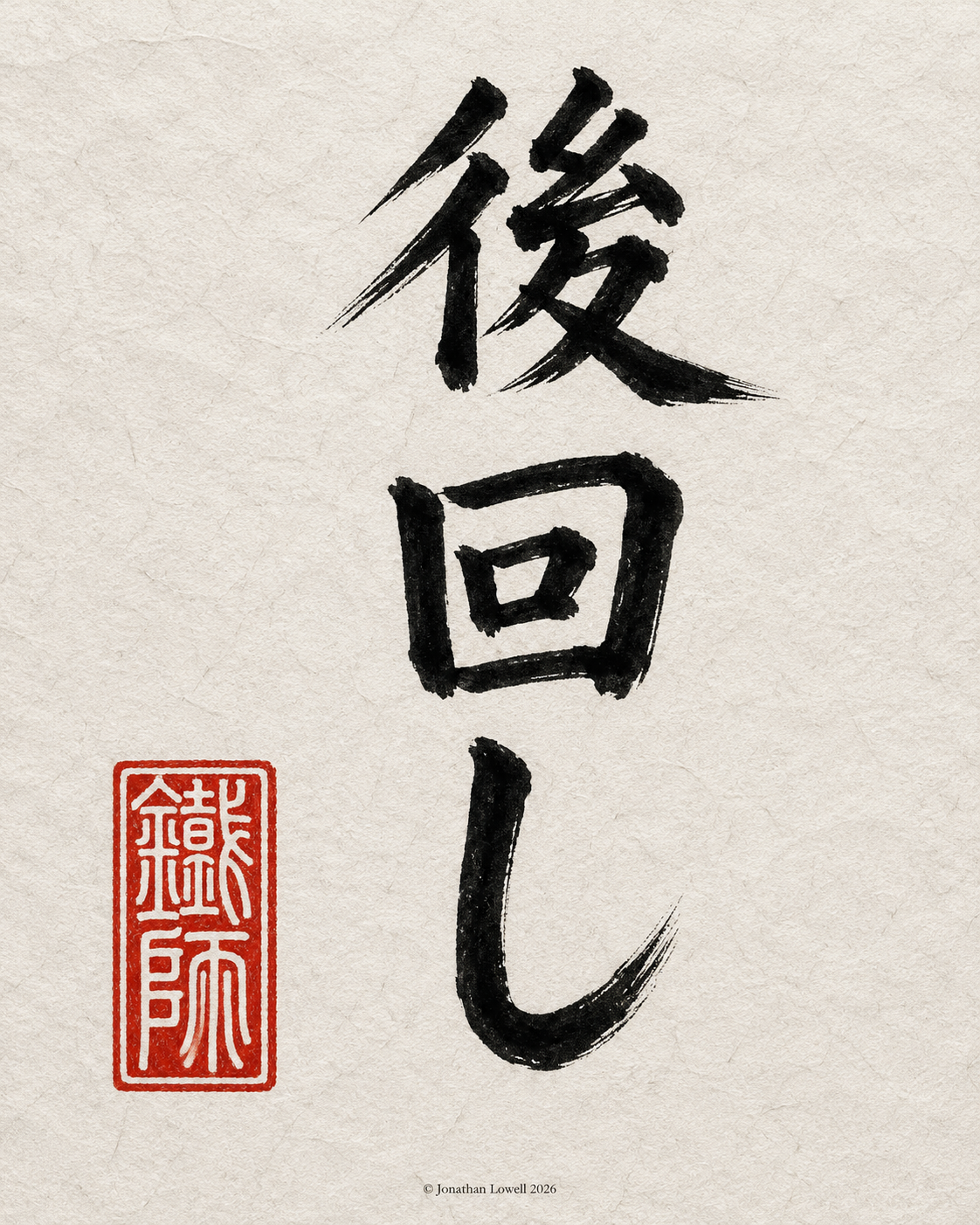
He called it "shunting."
To him, shunting meant pushing something off to the side. Delaying it. Finding something else to do instead of what really mattered.
The Japanese word is 後回し (atomawashi)—"getting around to it... later." to put something off until later.
Every one of us has done it.
"I'll start Monday."
"I'll lose weight next month."
"I'll write the book after I retire."
"I'll buy the domain later."
I almost waited to buy TheIronSensei.com.
Then I caught myself.
That wasn't planning.
That was atomawashi.
That was shunting.
The enemies are always the same:
Procrastination — waiting for the perfect time.
Laziness — avoiding effort.
Fear — avoiding failure... or even success.
Excuses — the stories we tell ourselves.
The answer is simple.
Roll up your sleeves.
Put on your hachimaki (Headband).
Take one step.
One phone call.
One workout.
One paragraph.
One decision.
Sensei Urban often said:
"Discipline is freedom."
I believe he was right.
No more atomawashi.
No more shunting.
Build today.
證 — Let the work be the proof.
About the Author
Jonathan Lowell, known as The Iron Sensei, has trained in Goju-Ryu Karate-Do for more than five decades. A student of Peter Urban and Morio Higaonna, he has competed, taught thousands of students, and operated his own dojo for over twenty years. He is also a licensed massage therapist, author of The Hallandale Diet, and founder of the online coaching program Iron Rebuild, where he helps men and women over 40 lose weight, build strength, improve their health, and regain confidence. Through The Iron Sensei Journal, he shares the history, philosophy, and living traditions of karate while drawing on a lifetime of training and continuous study.